ElectronsX > Autonomy > Autonomous Rail Hubs
Autonomy Overview > Autonomous Rail Hubs
Autonomous Rail Hubs
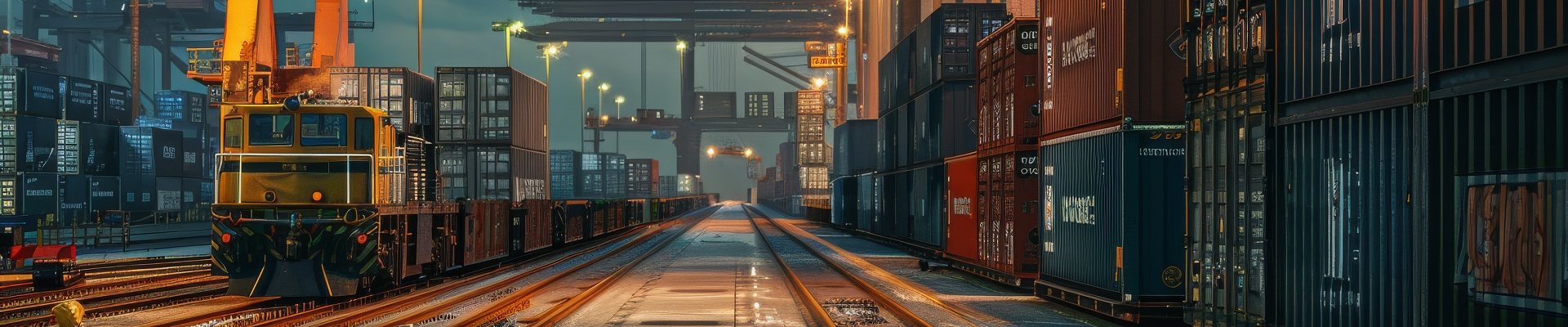
Rail yards and intermodal hubs are bounded sites where containers and trailers move between trains, trucks and handling equipment. They run on fixed corridors and train schedules, with large batch movements at each train arrival and departure.
Autonomy at rail hubs is uneven. Train slot planning, yard allocation and crane scheduling are already highly digital, while yard switching and safety around mixed crews and vehicles slow physical autonomy. ElectronsX classes rail hubs as Energy Autonomy Yards (EAY) in transition. An EAY is a yard where mobile equipment and on-site power are run as one system; at rail hubs the scheduling software is ready and the machines are catching up.
See: Energy Autonomy Yards (EAY)
Train Windows and Charging Peaks
When yard equipment and drayage trucks go electric, their charging peaks land in the same windows as train arrivals and departures, so the hub must schedule power alongside cranes and trucks. AI scheduling shortens container dwell and spreads charging across each window, and automated handling eases labor bottlenecks.
Rail Hub Autonomy Stack
Planning and dispatch lead; intermodal cranes, stackers and automated gates follow, depending on the site. Yard switching and coupling are the hardest tasks to automate because of safety rules and legacy equipment, so supervised autonomy with teleoperated recovery will dominate in the near term.
| Autonomy Layer | What's In It | Today's Maturity | Notes |
|---|---|---|---|
| Planning and dispatch | Train slots, yard allocation, crane scheduling, gate appointments | Very high | Digital orchestration leads |
| Handling automation | Cranes, stackers, automated gates (site-dependent) | Medium to high | Intermodal handling is increasingly automated |
| Switching and movements | Yard switching, coupling/decoupling, safety supervision | Medium | Hardest autonomy surface due to safety and legacy |
| Sensing & safety | Geofenced zones, intrusion detection, cameras/LiDAR at crossings | High | Safety perimeter is central |
| Teleoperation | Recovery and supervised autonomy | Medium to high | Hybrid models dominate near term |
Power for Signaling and Yard Equipment
- Segmented power for critical signaling and operations
- Charging for yard equipment and drayage fleets
- Battery energy storage (BESS) for peak reduction during train window surges
- Islanding for minimum viable operations during outages
Rail Hub Fleet Energy Depot (FED)
The Fleet Energy Depot (FED) at a rail hub is the charging, BESS and microgrid control system for yard equipment and drayage trucks. It connects the energy management system (EMS) to the yard scheduler and the truck appointment system, so BESS covers train-window peaks and drayage trucks charge in time for their gate appointments. Rail hubs involve several operators and legacy systems, so standard interfaces and contracts matter as much as hardware.
| FED > Facility Interface | Primary Data Signals | Control Integration | Design Notes |
|---|---|---|---|
| Train-window peak buffering | Arrival/departure windows, equipment queue depth | EMS > yard scheduler | BESS reduces interconnect size and tariff exposure |
| Drayage readiness | SOC, appointment time, gate throughput | Fleet manager > charger manager > appointment system | Charging aligns to appointments |
| Critical ops power | Signals, comms, safety system status | Microgrid controller executes priorities | Define minimum viable operations explicitly |
| Interoperability | Legacy systems, multiple stakeholders | API integration + governance | Standard interfaces and contracts matter |
See: Fleet Energy Depots (FED)
Key Metrics
| Metric | What It Measures | Why It Matters | Typical Targets / Notes |
|---|---|---|---|
| Dwell time | Time containers sit in yard | Primary throughput constraint | Autonomy reduces dwell via scheduling |
| Gate turn time | Truck in/out time | Customer SLA KPI | Disruptions propagate quickly |
| Crane moves per hour | Handling productivity | Operational KPI | Automation increases consistency |
| Peak kW during windows | Energy peaks during surges | Cost and capacity KPI | BESS + scheduling target this |
| Recovery time (disruption) | Time to resume baseline ops | Resilience KPI | Islandable critical subsystems matter |
Reference Deployments
- Port-adjacent intermodal hubs (Europe, China, North America)
- Digitally optimized rail yards with advanced appointment systems (emerging)
Adoption Drivers
| Rank | Adoption Driver | Why It Matters | Primary Constraint |
|---|---|---|---|
| 1 | Congestion and dwell cost | Reducing dwell unlocks throughput without expansion | Legacy constraints and multi-party governance |
| 2 | Peak energy windows | Train windows create synchronized peaks | Interconnect lead time and permitting |
| 3 | Predictable corridors | Fixed paths are autonomy-friendly | Safety constraints and mixed actors |
| 4 | Intermodal growth | More freight flows through nodes | Capex cycles and fragmentation |
| 5 | Standard interfaces | Scheduling APIs enable incremental autonomy | Data standards and procurement inertia |
Related Coverage
- Autonomous Factories
- Autonomous Logistics Hubs
- Autonomous Mines
- Autonomous Seaports
- Fleet Autonomy Architecture
- Fleet Autonomy Depot & Yard Integration
- Energy Autonomy Yards
- From Charging Depots to Fleet Energy Depots