ElectronsX > Vehicles > Off-Highway
Electric Off-Highway Equipment
Electric heavy equipment spans construction, mining, agriculture, forestry, seaports, and airports - the off-highway segment where electrification is advancing fastest in controlled, high-utilization environments. These are not consumer vehicles: they are industrial assets measured by total cost of ownership, uptime, payload capacity, and operating cost per tonne-kilometre. Electrification economics in off-highway are often more compelling than in passenger vehicles - particularly in mining and ports where fuel logistics, ventilation costs, and shift-based duty cycles make the TCO case for electric drive systems straightforward.
Off-highway is also where Level 4 autonomous operation is most commercially advanced. Caterpillar autonomous haul trucks operate at Rio Tinto's Pilbara mines. Autonomous port cranes and yard tractors are in production at Yangshan and Qingdao. The electrification and autonomy transitions are happening simultaneously in this segment - electric drivetrains simplify the integration of autonomous control systems by eliminating hydraulic complexity and enabling precise software-controlled torque delivery.
Segment Overview
| Segment | Key Equipment Types | Primary Driver | Autonomy Path | Directory |
|---|---|---|---|---|
| Mining | Haul trucks, underground loaders (LHDs), drills, mine service vehicles | Ventilation cost elimination (underground), fuel logistics savings, ESG mandates | Most advanced - Cat, Komatsu, BHP autonomous haul truck programs at scale | Mining Equipment → |
| Construction | Excavators, wheel loaders, bulldozers, compactors, concrete mixers, pavers | Urban emission mandates, zero-exhaust on enclosed sites, noise reduction | Early stage - autonomous compaction and grading pilots underway | Construction Equipment → |
| Agriculture | Tractors, harvesters, sprayers, autonomous field robots | Fuel/maintenance cost reduction, on-farm renewable compatibility, precision agriculture | Strong - autonomous tractors (John Deere 8R, Monarch MK-V) commercially available | Agriculture Equipment → |
| Forestry | Harvesters, skidders, forwarders, feller bunchers | Quiet operation in wilderness, reduced diesel logistics in remote sites | Emerging - remote-controlled and semi-autonomous forestry machines in pilot | Forestry Equipment → |
| Seaports & Terminals | Yard tractors, straddle carriers, reach stackers, RTG cranes, AGVs | Port emission mandates, IMO decarbonization, predictable duty cycles | Advanced - autonomous cranes and AGVs at Yangshan, Qingdao, Port of LA | Port Equipment → |
| Airport GSE | Baggage tractors, belt loaders, aircraft tugs, ground power units (GPU), de-icers | Emission mandates at gates, passenger/crew air quality, noise reduction | Pilots - autonomous pushback tractors and baggage tractors in airport trials | Airport Electrification → |
| Logistics & Warehouse | Forklifts, pallet movers, reach trucks, order pickers | Already well-electrified - lithium-ion replacing lead-acid; AMRs replacing manual | Mature - AMRs (Amazon Kiva/Proteus, Geek+, Quicktron) at scale | Logistics Hub Electrification → |
Mining - The Most Advanced Segment
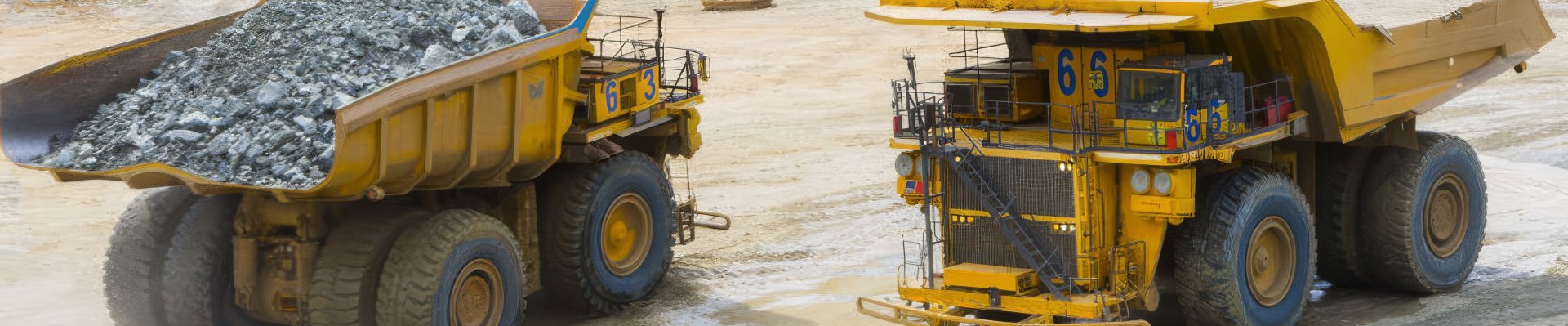
Mining is the off-highway segment furthest along in both electrification and autonomy. The economic case is uniquely compelling: underground mines spend 30-50% of operating cost on ventilation to remove diesel exhaust - a cost that drops dramatically when equipment is electrified. Surface mines benefit from fuel logistics simplification across remote sites. Both environments create high-utilization, predictable duty cycle conditions ideal for fleet electrification and autonomous operation.
Autonomous haul trucks are operational at scale: Caterpillar Command for Hauling at Rio Tinto's Pilbara operations, Komatsu FrontRunner at BHP and Fortescue, and Epiroc's autonomous underground loaders at multiple global mine sites. These represent the most commercially mature Level 4 autonomous vehicle deployments anywhere in the world - operating 24/7 without safety drivers in production environments.
Electric mining equipment OEMs: Epiroc (Sweden), Sandvik (Sweden), Caterpillar (US), Komatsu (Japan), Liebherr (Germany/Switzerland), XCMG and SANY (China scaling rapidly in surface mining).
Electric Mining Equipment Directory
Autonomous Mining
Autonomous Mines Overview
Construction
Electric construction equipment is driven primarily by urban emission mandates - EU Stage V/VI, California CARB Off-Road regulations, and city-level diesel bans on construction sites. Volvo CE, Caterpillar, Komatsu, Hitachi, and Doosan are all producing or piloting electric excavators, wheel loaders, and compact equipment. Chinese OEMs including XCMG, SANY, and Zoomlion are scaling electric construction equipment rapidly for domestic and export markets.
The highest-value construction electrification targets are the machines with highest utilization and fuel consumption: 20-35 tonne excavators and large wheel loaders. Battery sizing for these machines (200-600 kWh) creates demand that overlaps with EV traction pack supply chains at the cell level.
Electric Construction Equipment Directory
Autonomous Construction
Agriculture
Agricultural electrification combines energy cost reduction (tractors run ~2,000 hours/year - fuel savings are substantial) with precision agriculture integration. Electric drivetrains enable per-wheel torque control that improves traction and reduces soil compaction. On-farm solar and BESS creates a natural pairing - electric tractors charging from farm-generated renewable power is a closed energy loop that resonates with sustainability-oriented farming operations.
Autonomous agriculture is commercially real: John Deere's fully autonomous 8R tractor operates without a driver on defined fields. Monarch Tractor's MK-V is electric and autonomous. CNH (Case/New Holland) and AGCO are both fielding autonomous and electric programs. Chinese OEMs including YTO and Lovol are scaling electric tractors for Asian and emerging markets.
Electric Agriculture Equipment Directory
Autonomous Agriculture
Seaports & Terminal Equipment
Seaports are the canonical Energy Autonomy Yard (EAY) archetype - concentrated, schedulable electric loads with predictable duty cycles, centralized charging, and strong economic incentives for grid independence. Port electrification is driven by IMO decarbonization goals, local air quality mandates (CARB's Drayage Truck Regulation, EU port emission rules), and the operational benefits of electric cranes and yard tractors that can be precisely controlled and scheduled.
Electric Port & Terminal Equipment Directory
Seaport Electrification
Autonomous Seaports & Terminals
Energy Autonomy Yards (EAY)
Technology & Supply Chain
Off-highway equipment presents distinct technology challenges vs. on-road EVs. Battery sizing must accommodate high-torque, variable-duty-cycle operation without the range anxiety framing of consumer vehicles. Many applications use opportunity charging - partial recharge during operator breaks or shift changes - which changes the battery sizing and charging infrastructure calculus fundamentally vs. overnight depot charging.
Key supply chain nodes for off-highway electrification:
Large-format battery packs - 200-600 kWh packs for heavy equipment draw from the same LFP cell supply as BESS and commercial EV; thermal management for high C-rate discharge is the key design challenge
High-torque traction motors - permanent magnet motors with high pole count for low-speed torque; GOES electrical steel supply shared with EV and wind
Power electronics - SiC-based traction inverters at higher voltage (600-1000V bus common in heavy equipment) than passenger EVs
Charging infrastructure - opportunity charging at 150-350 kW for surface equipment; underground charging requires explosion-proof equipment and constrained cable routing
Battery Supply Chain
Motor & Drivetrain Supply Chain
Power Electronics Supply Chain
Market Outlook 2026-2030
| Segment | Electrification Pace | Autonomy Pace | Key Constraint |
|---|---|---|---|
| Mining | Fast - underground leading; surface scaling | Fastest - already at commercial scale | Battery energy density for largest haul trucks; charging at remote sites |
| Seaports | Fast - cranes and yard equipment leading | Advanced - AGVs and autonomous cranes operational | Shore power infrastructure; grid interconnection at large ports |
| Agriculture | Moderate - tractors scaling; large equipment slower | Strong - autonomous tractors commercially available | Battery range for full-day field operation; charging in remote fields |
| Construction | Moderate - compact equipment leading; large slower | Early - pilots in compaction and grading | Battery sizing for high-duty-cycle excavators; jobsite charging logistics |
| Forestry | Slow - remote sites, extreme conditions, battery weight | Emerging - remote control more realistic near-term than full autonomy | Battery weight penalty, rough terrain, charging logistics in wilderness |
| Airport GSE | Fast - strong regulatory and operational push | Early - autonomous tugs and baggage tractors in pilots | Airside safety certification for autonomous operation |
Related Coverage
Equipment Directories: Mining | Construction | Agriculture | Forestry | Port & Terminal
Autonomy: Autonomous Mining | Autonomous Construction | Autonomous Agriculture | Autonomous Mines
Infrastructure: Seaport Electrification | Airport Electrification | Logistics Hub Electrification | Energy Autonomy Yards
Supply Chain: Battery SC | Motor SC | Power Electronics SC