ElectronsX > Energy > Solar Energy
Solar Energy & PV Supply Chain
[Last updated: Mar 2026]
Solar photovoltaics deliver the lowest levelized cost of electricity (LCOE) of any generation source in most markets - and that cost continues to fall. Utility-scale solar is the dominant new generation technology globally, increasingly deployed as solar-plus-storage projects that address intermittency while providing grid flexibility. For the electrification ecosystem covered by ElectronsX, solar is also the default on-site generation layer for fleet depots, gigafactories, semiconductor fabs, and datacenters seeking energy autonomy.
This page covers two interlinked topics. As an Energy node it covers utility-scale solar deployment, grid integration, and emerging technology trends. As the PV Supply Chain node it covers the full upstream chain from polysilicon through wafer, cell, module, inverter, and balance of system - including the US reshoring push driven by IRA domestic content incentives and the geopolitical pressure on China's 80%+ share of global module manufacturing.
PV Supply Chain - Polysilicon to System
The PV supply chain runs from metallurgical-grade silicon (MG-Si) through multiple refining and manufacturing stages to finished solar installations. China dominates every stage - from polysilicon production (~80% of global capacity) through wafer, cell, and module manufacturing. The US and EU are actively reshoring select stages through IRA domestic content incentives (45X MPTC for cells and modules) and the EU Net-Zero Industry Act, but full supply chain independence remains a multi-decade project.
| Supply Chain Stage | Key Inputs | China Share | Coverage |
|---|---|---|---|
| MG-Si & Polysilicon | Quartz, coal/carbon, trichlorosilane; Siemens CVD or FBR process | ~80% global polysilicon capacity | Polysilicon Supply Chain |
| Silicon Wafers | Polysilicon ingot growth (Czochralski/cast), wire sawing, surface treatment | ~95% global wafer capacity | Solar Cell Manufacturing |
| Solar Cells | Wafers, dopants, anti-reflective coating, metallization pastes | ~85% global cell capacity; PERC dominant; TOPCon scaling | PV Cell Manufacturers |
| Solar Modules (Panels) | Cells, encapsulant (EVA), backsheet, glass, frame, junction box | ~80% global module capacity; US reshoring accelerating | Solar Panel Manufacturers |
| Solar Inverters | SiC/IGBT power semiconductors, capacitors, magnetics, DSP controllers | Huawei and Sungrow dominate global string inverter supply | Solar Inverter Manufacturers |
| Balance of System (BOS) | Racking, mounting, cables, combiners, trackers, transformers, monitoring | More regionally distributed; trackers concentrated in US/Spain/China | Solar Balance of Systems |
US Reshoring - IRA & Domestic Content
The Inflation Reduction Act 45X Advanced Manufacturing Production Credit provides per-unit incentives for US-manufactured solar cells and modules - $0.04/W for cells and $0.07/W for modules as of 2026. This has triggered a significant wave of US solar manufacturing investment. Key developments:
Qcells (Hanwha) - largest US solar manufacturer; 5.1 GW Dalton, GA facility; expanding with US cell production for full domestic content qualification
First Solar - only large-scale US CdTe (cadmium telluride) thin-film manufacturer; 10+ GW US capacity; IRA domestic content beneficiary
Heliene - US module assembly with domestic content strategy
REC Silicon - idled polysilicon plant in Moses Lake, WA exploring restart for US polysilicon supply
Corning - US solar glass and wafer substrate expansion
Tesla Solar - $2.9B equipment investment for US solar manufacturing capacity
Despite these investments, a fully domestic US PV supply chain (polysilicon through module) remains limited - most US module assembly still uses imported cells from Southeast Asia (Malaysia, Vietnam, Cambodia, Thailand) and imported wafers from China or Taiwan. The IRA domestic content rules for "10% adder" and "bonus credit" are driving incremental reshoring but full chain independence is a 2030+ scenario.
See: Solar Panel Manufacturers - US & Global | Advanced Manufacturing Tax Credits (45X)
PV Manufacturer Databases
ElectronsX maintains enriched manufacturer databases for each PV supply chain stage, updated in Q1 2026. These cover capacity, technology type, geography, IRA eligibility, and key product specs.
Solar Panel Manufacturers - 75 entries including US SEIA database and enriched global Tier 1; US reshoring coverage; Panasonic exit noted (Apr 2025)
Solar Inverter Manufacturers - 72 entries; string, central, microinverter, and hybrid inverter categories; SiC/GaN semiconductor mapping
Solar Cell Manufacturers - cell technology breakdown (PERC, TOPCon, HJT, IBC, CdTe, CIGS)
Polysilicon Producers - global and US capacity; MG-Si layer (Ferroglobe, Mississippi Silicon); Corning wafer facility; REC Silicon idled status
Solar Balance of Systems - BOS materials and components
Solar Storage Batteries - solar-paired BESS products
Turnkey Solar Systems - integrated system providers
US Solar Farms Database
Utility-Scale Solar Deployment
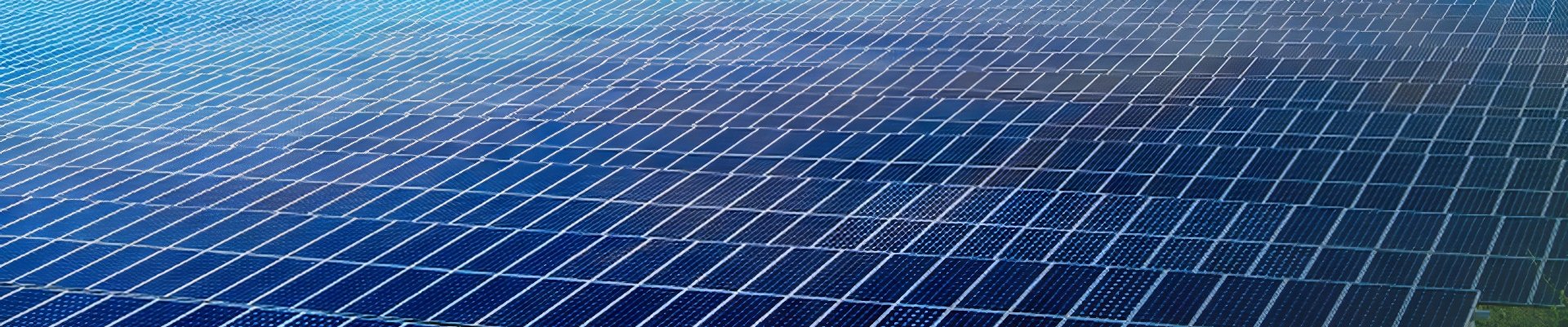
Utility-scale solar plants range from 100 MW to over 2,000 MW in nameplate capacity. They feed bulk electricity to regional grids and are increasingly co-located with grid-scale BESS and transmission infrastructure. Deployment clusters in high-insolation regions - US Southwest, Middle East, India, China, and Southern Europe - drive renewable capacity growth, grid flexibility, and energy transition planning.
Modern utility-scale solar is almost always deployed as solar-plus-storage. The BESS component handles the intermittency problem that was the primary barrier to high-penetration solar deployment - enabling the project to firm generation, shift production to evening peak demand, and provide ancillary grid services including frequency regulation and voltage support.
US Solar Farms Database
Grid-Scale BESS - Co-Location Architecture
Grid Integration & Transmission
Grid Integration
Solar generation is inherently variable - following daily and seasonal production patterns with zero generation at night and reduced output on cloudy days. As utility-scale solar penetration increases, grid integration becomes the primary system design challenge. Three mechanisms address variability:
BESS co-location - shifts generation from midday peak production to evening demand peak; enables capacity market participation; provides synthetic inertia when paired with grid-forming inverters
Grid interconnection & transmission - large solar clusters require transmission buildout; interconnection queue timelines of 3-7 years are the current binding constraint on US solar deployment
Demand response & DR programs - large solar sites participate in demand response, curtailment management, and ancillary service markets through EMS/SCADA
See: Grid Infrastructure & Modernization | Grid Edge & DER Integration
On-Site Solar for the Electrification Ecosystem
Beyond utility-scale, distributed solar is the standard on-site generation layer for electrification infrastructure. Solar canopies over EV charging depots, rooftop solar on gigafactories, ground-mount arrays at semiconductor fabs, and carport canopies at fleet logistics hubs all reduce grid exposure, lower demand charges, and improve energy autonomy scores under the Six Foundation Domains framework.
| Application | Typical Configuration | Primary Benefit |
|---|---|---|
| EV Charging Depot / FED | Solar canopy 0.5-5 MW + BESS | Demand charge reduction; green charging credentials; peak shaving with BESS |
| Gigafactory | Rooftop + ground-mount 10-50 MW + PPA | Renewable PPA for IRA domestic content; energy cost; ESG reporting |
| Semiconductor Fab | Ground-mount 20-100 MW + microgrid | Power cost reduction; partial renewable sourcing; resilience with BESS |
| Logistics Hub / Seaport | Canopy / rooftop 1-10 MW + BESS | EAY architecture; port emission mandate compliance; fleet charging support |
| Luxury Estate (LuxeAutonomy) | Integrated rooftop/ground-mount + Powerwall/Powerpack | Full energy sovereignty; silent operation; V2H capability |
Supply Chain Bottlenecks
| Bottleneck | Why It Matters | Mitigation |
|---|---|---|
| Polysilicon concentration | ~80% Chinese production; Xinjiang forced labor compliance risk; tariff exposure | US/EU polysilicon reshoring; SE Asia diversification; supply chain traceability (UFLPA) |
| Inverter semiconductor supply | SiC and IGBT supply shared with EV, BESS, EVSE, and grid simultaneously | Multi-sourcing; strategic inventory; SiC design-for-substitution |
| Module logistics | Heavy modules, long-distance transoceanic shipping, port congestion risk | Localized manufacturing; regional warehousing; on-site assembly |
| Grid interconnection queue | 3-7 year interconnection queues in US; largest single constraint on utility solar deployment | Policy reform (FERC Order 2023); co-location with BESS to reduce interconnection size; early queue filing |
| UFLPA compliance | Uyghur Forced Labor Prevention Act creates rebuttable presumption for Xinjiang-origin polysilicon | Supply chain traceability documentation; non-Xinjiang sourcing; US-manufactured modules |
Emerging Technology Trends
TOPCon & HJT - replacing PERC as mainstream cell technology; higher efficiency (22-25%+); LONGi, Jinko, JA Solar leading TOPCon; REC, Panasonic (pre-exit), Meyer Burger leading HJT
Perovskite-silicon tandem - pilot production at Oxford PV, LONGi; theoretical efficiency above 45%; commercial scale 2027-2030
Solar-plus-storage as default - standalone utility solar without BESS increasingly rare in new projects; co-location is now the procurement standard
Agrivoltaics - dual-use solar/agriculture; reduces land use conflict; improves political acceptance
Floating solar - hydropower dam retrofits; reservoir surface deployment; reduces evaporation; growing in Asia
Bifacial modules - now standard for utility-scale; rear-side gain of 5-30% depending on albedo and ground clearance
Related Coverage
PV Supply Chain: Panel Manufacturers | Inverter Manufacturers | Cell Manufacturers | Polysilicon | Balance of Systems
Deployment Data: US Solar Farms | US Solar Installers | Turnkey Solar Systems | Solar Storage Batteries
Energy Integration: BESS | Microgrids | Grid Infrastructure | Energy Orchestration
Policy: 45X Advanced Manufacturing Credits | Residential Solar Tax Credits
Supply Chain Convergence: Convergence Map | Inverter Power Electronics SC | SiC & GaN Substrate