ElectronsX > Energy > BESS > BESS System Products
BESS System Products
[Last updated: Apr 2026]
Battery Energy Storage Systems (BESS) are offered in many sizes and configurations, from massive utility-scale projects to compact residential units and even portable power banks. Vendors provide the technologies and turnkey solutions that enable storage to integrate with solar, wind, and the broader grid—delivering flexibility, reliability, and resilience across applications.
Grid/utility battery storage
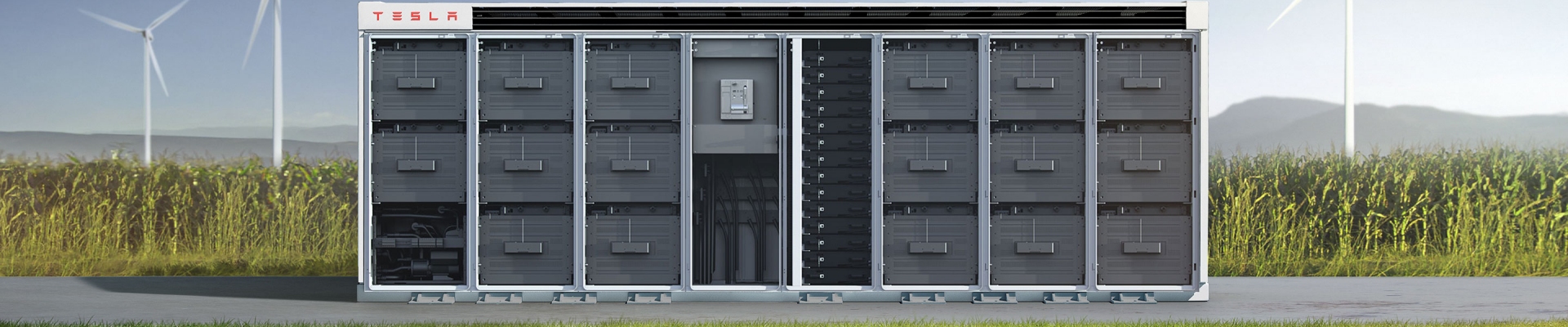
At the grid and utility level, containerized BESS deployments supply hundreds of megawatt-hours of capacity, supporting peak shaving, renewable firming, black start capability, and wholesale market participation. These systems are critical for utilities, data centers, and industry.
| Vendor | Product | Origin |
|---|
Residential battery storage
For residential customers, whole-house solar batteries and small-scale BESS units provide self-consumption, outage protection, and participation in emerging virtual power plants (VPPs). These products often include lithium-ion or lithium iron phosphate (LFP) chemistries, integrated inverters, and smart monitoring systems for simple deployment. Tesla Powerwall is a popular example.
| Vendor | Product | Origin |
|---|
Portable battery power stations
Portable solutions—ranging from compact power stations to larger transportable battery banks—extend energy access into remote areas, construction sites, camping, and off-grid applications. They are increasingly replacing diesel generators in both consumer and commercial markets.
| Vendor | Product | Origin |
|---|
Power and Energy Density
Table shows the clear advantages of using lithium-ion and other battery chemistries in energy storage systems. Power and energy density values (given in volumetric liter units) are off the charts compared to other commonly-used storage technologies for commercial/grid applications.
| Technology | Power Density (W/kg) | Energy Density (Wh/kg) | Typical Use Cases |
|---|---|---|---|
| Pumped Hydro Storage | ~0.5 - 1 | ~0.3 - 1 | Utility-scale, long-duration (GWh) storage; grid balancing |
| Compressed Air Energy Storage (CAES) | ~2 - 6 | ~2 - 6 | Utility-scale, cavern or tank storage; long-duration backup |
| Lead-Acid Batteries | ~180 | ~30 - 50 | Backup power (UPS), off-grid, legacy low-cost systems |
| Lithium-Ion Batteries | ~250 - 400 | ~150 - 250 | Residential, commercial, utility-scale BESS, EVs |
| Solid-State Lithium Batteries | ~300 - 500 | ~250 - 400 | Next-gen EVs, aerospace, future residential/portable storage |
| Sodium-Ion Batteries | ~150 - 250 | ~100 - 160 | Low-cost stationary storage, grid applications, potential Li-ion alternative |
| Vanadium Flow Batteries | ~30 - 50 | ~20 - 40 | Long-duration grid storage, 4-12 hour cycles, high cycle life |
| Zinc-Air / Metal-Air Batteries | ~100 - 300 | ~300 - 500 (theoretical) | Emerging for long-duration storage, research and pilot projects |
| Hydrogen (as storage medium) | Highly variable | ~30 - 40 (compressed) | Seasonal storage, power-to-gas-to-power, industrial scale |
| Flywheel Storage | ~500 - 5000 | ~5 - 30 | Frequency regulation, UPS, short-duration grid support (seconds-minutes) |
| Supercapacitors / Ultracapacitors | ~1000 - 10,000 | ~1 - 10 | Power smoothing, regenerative braking, bridging short outages |
| Thermal Energy Storage (TES) | Variable | ~30 - 150 (material dependent) | Concentrated solar power (molten salt), industrial heat, district energy |
| Gravity-Based Storage | ~1 - 5 | ~20 - 100 | Utility-scale long-duration pilots, modular pumped-hydro alternatives |
No single storage technology is optimal for every application. Lithium-ion currently dominates short- to medium-duration storage thanks to its high energy density and modular design, making it ideal for residential, commercial, and utility BESS. Pumped hydro and compressed air remain unmatched for seasonal or ultra-long-duration storage at the grid scale, despite low energy density. Flow batteries offer durability and flexible cycle life for long-duration projects, while sodium-ion is emerging as a low-cost alternative for stationary storage. Solid-state and metal-air batteries promise major leaps in density and safety but are still in development. Together, these options form a complementary toolkit, ensuring storage can scale across every layer of the energy ecosystem.