
ElectronsX > Fleets > Fleet Charging > EV Charging Connectors & Standards
EV Charging Connectors & Standards
EV charging connectors and standards define how electric vehicles interface with charging equipment. They determine power levels, communication protocols, and interoperability between vehicles and charging networks. As EV adoption grows, standardization is critical for ensuring reliable, safe, and convenient charging across passenger cars, fleets, and heavy-duty vehicles.
Connector voltage and current ranges map closely to vehicle segments and use cases. Passenger EVs typically charge at lower voltages (200-400 V) and benefit from AC Level 1 or Level 2 connectors for overnight or workplace charging. Premium EVs and light commercial vehicles increasingly use 800 V architectures, allowing faster DC charging through CCS, NACS, or GB/T. Heavy-duty trucks and buses require even higher voltages and currents—well above 1,000 V and up to 3,000 A—which is why the Megawatt Charging System (MCS) standard is being developed. These different connector standards ensure that charging infrastructure evolves in step with the energy demands of each vehicle class, from compact cars to long-haul freight.
EV charging connectors are defined both by their standards (which set design, safety, and interoperability rules) and by their electrical specifications (voltage, current, and power levels):
> Level 1 (120V AC trickle at home) - the most deployed method today.
> Level 2 (240V AC) - residential, workplace, Destination Chargers, and public.
> DCFC (Level 3) (50-350 kW) - CCS, CHAdeMO, Tesla Superchargers.
> Ultra-fast (350 kW+ and MCS) - V4 Superchargers, heavy-duty freight.
Connector Standards Overview
This table lists the main connector standards used worldwide, their regions of adoption, and key notes on interoperability and market position.
| Connector | Standard | Region / Adoption | Notes |
|---|---|---|---|
| Tesla NACS | SAE J3400 (NACS) | North America, expanding globally | Tesla’s connector; adopted by most U.S. OEMs; supported by Supercharger network |
| J1772 | SAE J1772 (Type 1) | North America | Primary AC connector for L1/L2 charging in U.S. and Canada |
| Type 2 (Mennekes) |
IEC 62196 (Type 2) | Europe, parts of Asia | Supports 3-phase AC; EU standard for AC charging |
| CCS1 | SAE J1772 Combo (CCS1) | North America | Adds DC pins to J1772; backward compatible with AC |
| CCS2 | IEC 62196 Combo (CCS2) | Europe, parts of Asia | Mandated in EU; combines Type 2 AC + DC fast charging |
| CHAdeMO | CHAdeMO Standard | Japan, legacy in U.S./EU | Supports V2G; declining outside Japan |
| GB/T (Guobiao) |
China GB/T Standard | China | National standard; evolving toward harmonization |
| MCS | Megawatt Charging System (ISO/SAE draft) | Global (in development) | Designed for heavy-duty trucks and buses |
While standards determine compatibility and market adoption, the actual performance of each connector is governed by its electrical limits. The second table below shows the voltage, current, and power ranges supported by each connector type, highlighting how they scale from passenger cars to heavy-duty freight.
Connector Electrical Specifications
| Connector | Voltage (V) | AC / DC | Current (A) | Power (kW) |
|---|---|---|---|---|
| Home Charger (J1772 or NACS AC) |
120 | AC | 12-16 | 1-2 |
| Tesla Destination Charger | 208-240 | AC | 40-80 | 7-19 |
| Tesla Supercharger V2 | 400 | DC | ~300 | Up to 150 |
| Tesla Supercharger V3 | 400 | DC | ~630 | Up to 250 |
| Tesla Supercharger V4 | 500-1000 | DC | ~615+ | Up to 350 (scalable higher) |
| J1772 (Type 1) |
120-240 | AC | 12-80 | 1-19 |
| Type 2 (Mennekes) |
230-400 | AC | 16-63 | 3.7-43 |
| CCS1 (Combo 1) |
200-1000 | DC | Up to 500 | Up to 350 |
| CCS2 (Combo 2) |
200-1000 | DC | Up to 500 | Up to 350 |
| CHAdeMO | 200-500 | DC | Up to 125 | Up to 62.5 (400 kW in latest versions) |
| GB/T (Guobiao) |
200-1000 | DC | Up to 600 | 250-600 |
| MCS (Megawatt Charging System) | Up to 1250 | DC | Up to 3000 | 1-3+ MW |
Connector Notes
- Home Charger (J1772 or NACS AC): Level 1 standard 120V wall outlet; overnight trickle charging at home.
- Tesla Destination Charger: Level 2 AC charging; installed at hotels, resorts, and long-dwell sites.
- Tesla Supercharger V2: DCFC; older generation with shared power across paired stalls.
- Tesla Supercharger V3: DCFC; dedicated 250 kW per stall, widely deployed in North America.
- Tesla Supercharger V4: DCFC; supports higher-voltage EVs, longer cables for non-Tesla EVs.
- J1772 (Type 1): Level 1 / Level 2 AC charging; U.S. non-Tesla standard.
- Type 2 (Mennekes): Level 2 AC charging; EU-mandated connector, supports 3-phase.
- CCS1 (Combo 1): DCFC; primary fast charging standard in North America until the NACS transition.
- CCS2 (Combo 2): DCFC; mandated across EU, compatible with Type 2 AC.
- CHAdeMO: DCFC; legacy outside Japan, still used for V2G projects.
- GB/T (Guobiao): DCFC; China's mandated national connector.
- MCS (Megawatt Charging System): DCFC; heavy-duty freight connector under development.
EV charging plugs & connector ports
NACS (Tesla) is by far the most common EV plug type/connector for all EVS in the U.S., and gaining adoption in Canada and Mexico.
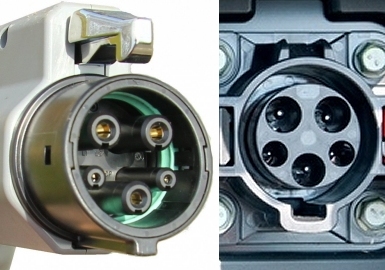
SAE J1772 J-plug
AC Level 1,2 - USA, Japan
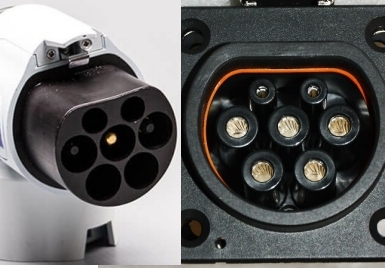
IEC 62196
AC Level 1,2 - China
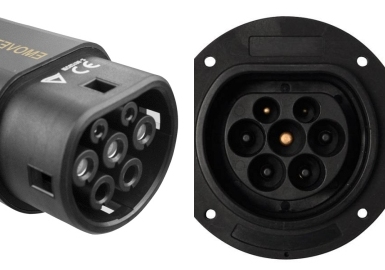
IEC 62196-2 Mennekes
AC Level 2 - EU
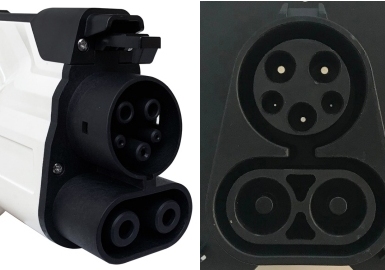
SAE J1772 CCS Combo 1
DC Level 2 - USA
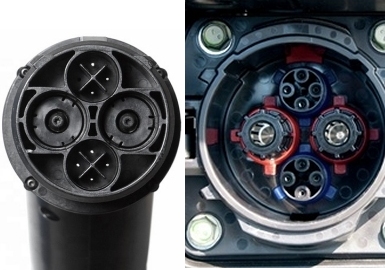
JEVS G105 CHAdeMO
DC Level 2 - Japan
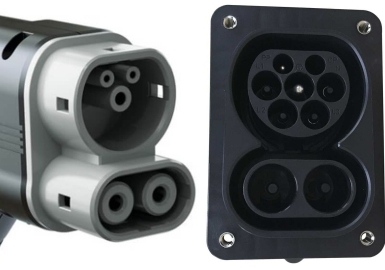
IEC 62196-3 CCS Combo 2
DC Level 2 - EU
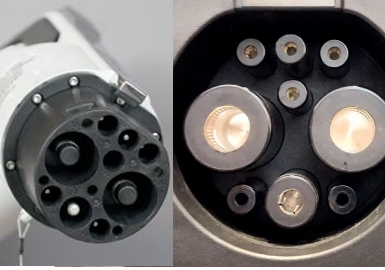
GB/T 20234.3 Guobiao
DC Level 2 - China
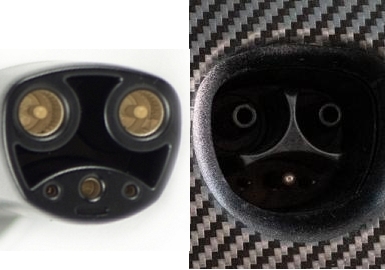
NACS (SAE J3400)
DC Level 2/3 - USA
Integration and Trends
- NACS is gaining rapid adoption in North America, with most automakers and networks committing by 2025
- CCS remains critical for interoperability during the transition phase
- CHAdeMO is in decline outside Japan, but V2G (vehicle-to-grid) projects still use it
- GB/T dominates the Chinese market, with potential convergence toward CCS/NACS in future standards
- MCS is emerging as the heavy-duty charging backbone, aligned with freight electrification
Market Outlook & Adoption
| Connector / Standard | Key Driver | Outlook |
|---|---|---|
| Tesla NACS (North American Charging Standard) | Adopted by nearly all U.S. OEMs | Growing |
| CCS1 / CCS2 (Combined Charging System) | EU mandate, global automaker backing | CCS2 strong; CCS1 declining |
| GB/T (China) | National standard, largest EV market | Regional |
| MCS (Megawatt Charging System) | Heavy-duty freight electrification | Emerging |
| CHAdeMO | Mature in Japan; V2G support | Declining |
- Tesla NACS: Adopted by nearly all U.S. OEMs; wide Supercharger network; compact, high-power design. Transition period as networks retrofit; regulatory alignment pending in some states.
- CCS1 / CCS2: Global automaker backing; EU mandate; backward compatibility with AC charging. The U.S. is shifting toward NACS; CCS1 may decline after 2030 but CCS2 stays strong in the EU.
- GB/T: National standard in the world's largest EV market; high-volume deployments. Potential future harmonization; limited adoption outside China.
- MCS: Enables heavy-duty freight electrification; global industry consortium support. Standard still under development; infrastructure rollout 2025-2030.
- CHAdeMO: Mature technology in Japan; supports vehicle-to-grid (V2G) applications. Rapid decline in North America/EU; replaced by CCS and NACS.
Related Coverage
- Fleet Depot Charging Costs: All-In Cost per kWh
- Public DCFC Costs: What EV Drivers Really Pay
- Tesla Cybercab & Semi Depots: Lowest Charging Costs in the World
- Autobidder for Fleet Operators
- EV Bidirectional Charging Models (V2X)