ElectronsX > Vehicles > Electric Aviation
Electric Aviation
Electric aviation covers the electrification of flight across four distinct segments: eVTOL air taxis for urban mobility, regional electric aircraft for short-haul routes, general aviation training aircraft, and hybrid-electric platforms bridging battery limitations. These segments have fundamentally different technology requirements, certification pathways, and commercial timelines — ranging from training aircraft already in certified commercial operation today to commercial jets where battery electrification remains a post-2040 scenario.
The defining constraint across all segments is battery gravimetric energy density. Automotive LFP and NMC cells at 200-300 Wh/kg are adequate for short-range eVTOL missions of 30-60 miles. They are insufficient for regional routes above 200 miles without hybrid-electric assist, and completely infeasible for commercial jet ranges. Solid-state batteries targeting 400-500 Wh/kg are the technology unlock that would extend electric aviation's viable envelope — but commercial solid-state at aviation-grade reliability remains a 2028-2035 development horizon.
Cargo drones and UAVs are covered separately under the Drones & UAVs page. This page focuses on crewed and passenger-class electric aircraft.
Aviation Segment Taxonomy
| Segment | Aircraft Classes | Range | Commercial Status | Key Constraint |
|---|---|---|---|---|
| eVTOL / Air Taxis | Electric vertical takeoff and landing; multirotor, tilting rotor, lift+cruise | 25-100 miles | Certification phase - Joby, Archer approaching FAA type certificate; EHang certified in China (2023) | FAA/EASA type certification; vertiport infrastructure; public acceptance |
| Training Aircraft | 2-seat electric trainers | 50-100 miles | Commercial - Pipistrel Velis Electro certified; Bye Aerospace eFlyer in certification; growing fleet adoption | Battery endurance for training flights; charging turnaround at flight schools |
| Regional Electric | 9-30 seat commuter aircraft; all-electric or hybrid-electric | 100-400 miles (hybrid); under 200 miles (all-electric) | Prototype/early certification - Heart Aerospace ES-30, Eviation Alice, Tecnam P-Volt | Battery energy density for range; certification of novel propulsion; grid infrastructure at regional airports |
| Hybrid-Electric | Turbine + electric assist; distributed electric propulsion with turbine range extender | 500-2,000 miles (turbine-dominant) | Development - Rolls-Royce, GE, Pratt & Whitney all active programs; no commercial product yet | Integration complexity; certification of novel architecture; weight penalty vs pure turbine |
| Hydrogen-Electric | Fuel cell electric propulsion; H2 combustion turbine | 300-1,000+ miles | Development - ZeroAvia leading fuel cell; Airbus ZEROe program; no certified product | H2 storage and airport infrastructure; fuel cell power density; certification |
| Commercial Jets | 100+ seat mainline aircraft | 500-8,000 miles | Long-term - battery electrification not feasible; SAF and hydrogen are the 2030-2050 pathways | Energy density physics; weight; range requirements incompatible with any foreseeable battery chemistry |
eVTOL Air Taxis - The Defining Near-Term Segment
eVTOL (electric vertical takeoff and landing) aircraft are the highest-profile and highest-investment electric aviation segment. They operate as autonomous or piloted air taxis on short urban and suburban routes — airport transfers, cross-city hops, resort connections — carrying 2-6 passengers at speeds of 100-200 mph over distances of 25-60 miles. The commercial premise is eliminating ground traffic on constrained urban corridors where a 15-minute flight replaces a 90-minute drive.
The business model depends on vertiport infrastructure (rooftop or ground-level takeoff/landing pads with charging), FAA type certification for autonomous or reduced-crew operation, and battery cost and energy density sufficient for 5-6 flights per charge cycle at competitive per-seat pricing. None of these are trivially solved. The FAA certification process for a novel aircraft category is the longest lead-time item — Joby filed its type certificate application in 2020 and is expected to receive it in 2025-2026 after completing the most demanding certification campaign in recent aviation history.
Leading eVTOL Platforms
| Platform | Developer | Certification Status | Specs | Key Partnership |
|---|---|---|---|---|
| Joby S4 | Joby Aviation (US) | FAA G-1 certification basis agreed; Stage 4 of 5 complete; type certificate expected 2025-2026 | 5 seats (1 pilot + 4 pax); 200 mph; 100+ mile range; 6 tilting rotors | Delta Airlines (launch partner); Toyota investment; USAF contract |
| Midnight | Archer Aviation (US) | FAA certification in parallel with Joby; flight testing ongoing | 5 seats; 150 mph; 60-mile range; 12 fixed rotors + 2 pusher props | United Airlines (100 aircraft order); Abu Dhabi partnership; Stellantis manufacturing |
| EHang EH216-S | EHang (CN) | CAAC (China) type certificate issued October 2023 - first eVTOL certified anywhere; commercial operations in China | 2 seats; 80 mph; 22-mile range; 16-rotor autonomous multicopter | Saudi Arabia, UAE, and SE Asia expansion; Dubaï and Singapore pilots |
| CityAirbus NextGen | Airbus (EU) | EASA certification in progress; first flight 2023 | 4 seats; 75 mph; 50-mile range; fixed-wing with 8 electric rotors | Airbus internal program; multiple airline LOIs |
| Wisk Cora | Wisk Aero (US/Boeing + Kitty Hawk) | FAA certification; autonomous-only (no pilot); most advanced autonomous eVTOL certification | 1 passenger; fully autonomous; 110 mph; 26-mile range | Boeing; Air New Zealand; New Zealand CAA approval pathway |
| Volocopter VoloCity | Volocopter (DE) | EASA Special Condition compliance; Singapore CAA approval; Dubai and Singapore pilots completed | 2 seats; 68 mph; 22-mile range; 18-rotor multicopter | GAIA vertiport network; Singapore launch partner |
eVTOL & Autonomous Aviation Directory →
Training Aircraft - The Commercially Mature Segment
Electric training aircraft are the most commercially advanced crewed electric aviation category. The economics are compelling: electric trainers eliminate $80-120/hour fuel costs, reduce maintenance (no oil changes, fewer moving parts), and operate more quietly — enabling training at noise-sensitive airports. Flight schools in Europe and the US are adopting electric trainers at a meaningful rate.
Pipistrel Velis Electro - first certified electric aircraft for commercial pilot training (EASA, 2020); 50-min endurance; Rotax E-811 motor; widely deployed at European flight schools
Bye Aerospace eFlyer 2 / eFlyer 4 - FAA certification in progress; 2-seat and 4-seat variants; targeting US Part 141 flight school market
Tecnam P-Volt - hybrid-electric 19-seat commuter developed with Widerøe; training and regional use
Pipistrel Virus SW 128 - ultralight trainer; widely used in Europe
ElectraFlyer / MagniX-powered conversions - retrofit programs converting existing airframes to electric propulsion
Electric Training Aircraft Directory →
Regional Electric & Hybrid-Electric Aircraft
Regional electric aircraft targeting 9-30 seats and 100-400 mile routes represent the next commercial frontier after eVTOL. Battery energy density at current levels limits all-electric regional routes to under 200 miles — viable for island-hopping, coastal commuter routes, and specific high-frequency short corridors. Hybrid-electric extends viable range to 400+ miles by combining electric propulsion with turbine range extension.
Heart Aerospace ES-30 - 30-seat hybrid-electric regional; 200-mile all-electric range, 400-mile hybrid; United Airlines and Air Canada orders; Swedish OEM
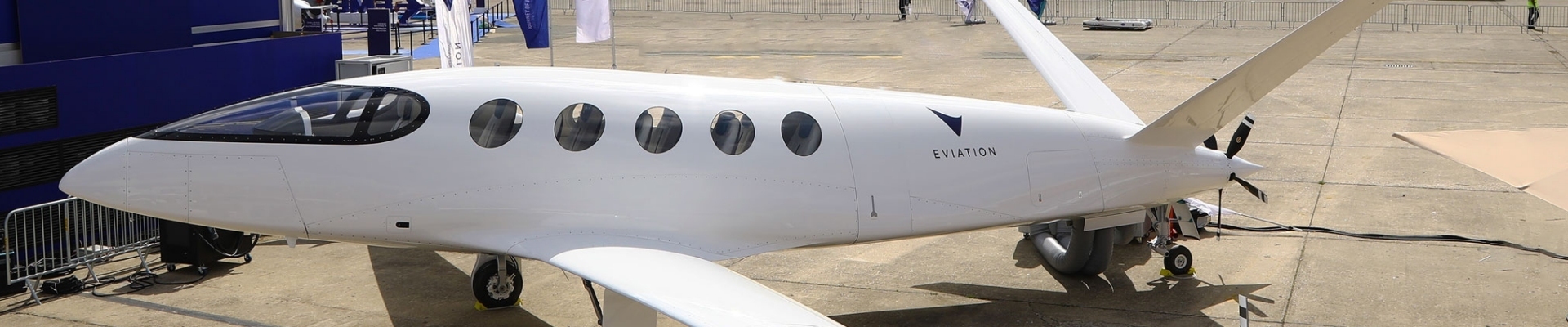
Eviation Alice - 9-seat all-electric commuter; MagniX motors; Cape Air launch customer; first flight 2022; certification in progress
Ampere Avinor - Norwegian all-electric 2-seat research platform; Avinor (Norwegian airports) development partner
ZeroAvia HyFlyer / ZA-600 - hydrogen-electric fuel cell powertrains for 9-20 seat regional aircraft; retrofitting existing Dornier 228 and Cessna Caravan platforms; UK CAA and FAA certification programs
Rolls-Royce / easyJet Spirit of Innovation - all-electric aircraft speed record holder (387 mph, 2021); demonstrator program
Technology Stack
| Component | Aviation Role | Key Constraints vs. Ground EV |
|---|---|---|
| Battery Pack | Primary energy source; weight is the binding design constraint | Gravimetric energy density (Wh/kg) critical - every kg of battery displaces payload; thermal runaway containment in pressurized cabin; DO-311A aviation battery standard |
| Electric Motors & Propulsors | Direct-drive fans, tilting rotors, distributed electric propulsion | Extremely high reliability requirement; redundancy mandated by certification; motor failure must not result in loss of control; DO-160G environmental qualification |
| Power Electronics | Inverters, converters, HV bus management; 600-800V typical for eVTOL | Thermal management at altitude (lower air density reduces convective cooling); weight and volume minimization; EMI compliance for avionics |
| Flight Control & Avionics | Stability, navigation, eVTOL fly-by-wire, autonomous flight management | DO-178C software certification; DAL-A for flight-critical software; FAA AC 21.17-4 for novel propulsion; redundant flight control architectures required |
| Hydrogen Fuel Cell | Range extender or primary propulsion for hydrogen-electric platforms | Cryogenic or 700-bar H2 storage weight and volume; fuel cell power density; airport H2 infrastructure |
Vertiport Infrastructure
Vertiports are the airport equivalent for eVTOL — dedicated takeoff, landing, and charging facilities designed for high-frequency urban air taxi operations. A commercial eVTOL service requires vertiports at both ends of each route, each with multiple simultaneous charging pads capable of 300-500 kW per aircraft to support 5-10 minute turnaround times between flights.
Vertiport development is being led by dedicated operators (Skyports, Ferrovial Vertiports, Urban-Air Port) and by airports adding eVTOL infrastructure to existing terminals. Key challenges: airspace management and separation from conventional aircraft, noise certification for rooftop urban sites, structural load requirements for rooftop pads, and grid capacity for simultaneous high-power charging.
Skyports (UK) - leading vertiport developer; Singapore Skyport (first operational vertiport for EHang); Dubai, London, and US expansion
Ferrovial Vertiports (ES/US) - airport operator developing US vertiport network; partnership with Joby Aviation
Urban-Air Port (UK) - Air-One pop-up vertiport demonstrator; Coventry UK first deployment
GAIA (NL) - Volocopter vertiport network partner; Singapore and EU deployments
Certification Framework
Aviation certification is the most rigorous and longest-lead-time element of any electric aviation program. The FAA and EASA have developed novel certification frameworks specifically for eVTOL that did not exist before 2020:
FAA Special Class (21.17(b)) - used for novel eVTOL aircraft not fitting existing categories; Joby and Archer certifying under this pathway with agreed G-1 Certification Basis
EASA SC-VTOL - Special Condition for VTOL aircraft; Basic, Enhanced, and Complex categories based on operational requirements
CAAC (China) - EHang EH216-S received type certificate October 2023 — first eVTOL type certificate issued by any civil aviation authority globally
DO-178C / DO-254 - software and hardware certification standards for airborne systems; DAL-A (highest criticality) for flight-critical functions
DO-311A - aviation battery standard covering rechargeable lithium batteries for airborne applications
Adoption Outlook 2026-2030
| Segment | 2026-2030 Outlook | Key Milestone | Constraint |
|---|---|---|---|
| Training Aircraft | Strong growth - commercially proven | Bye Aerospace eFlyer FAA certification; European fleet expansion | Battery endurance for longer training sorties |
| eVTOL (crewed air taxis) | Commercial launch 2025-2027 in limited corridors | Joby and Archer FAA type certificate; first US commercial routes | Certification, vertiport buildout, per-seat economics at scale |
| Regional Electric | Limited deployment on short routes | Eviation Alice certification; Heart ES-30 entry into service | Battery energy density; range limitations; airport infrastructure |
| Hydrogen-Electric | Regional pilots; no commercial service | ZeroAvia ZA-600 certification; airport H2 infrastructure pilots | H2 airport infrastructure; fuel cell power density; certification |
| Commercial Jets | SAF dominant; hybrid distant | SAF blending mandates (EU 2% by 2025, 6% by 2030) | Battery physics; range requirements; fleet replacement timelines |
Related Coverage
Aircraft Directories: eVTOL & Autonomous Aviation | Electric Training Aircraft | Cargo Drones & UAVs
Technology: Battery Supply Chain | Power Electronics SC | Autonomous Vehicles & Machines
Infrastructure: Airport Electrification & GSE | Charging Infrastructure
Parent: Vehicles Hub