ElectronsX > Energy > BESS
Battery Energy Storage Systems
Battery energy storage systems store electrical energy for later use — enabling power to be shifted across time rather than generated on demand. BESS is the fastest-growing energy asset class globally, driven by falling LFP cell costs, renewable integration requirements, grid stability mandates, and the need for energy autonomy at fleet depots, datacenters, semiconductor fabs, and industrial campuses.
BESS does not produce electricity — its value lies in controlling when and how stored energy is delivered within an energy system. That controllability makes BESS the enabling technology for the transition from synchronous-generator-based grids to inverter-dominated grids with high renewable penetration. Grid-forming BESS — running virtual inertia control algorithms — is now replacing the frequency stability that retiring coal and gas plants previously provided through rotational mass.
The BESS supply chain is a direct extension of the EV battery supply chain. The same LFP cells produced by CATL, BYD, and LGES serve both EV traction packs and utility-scale Megapacks. The same SiC power semiconductors in EV traction inverters are required in BESS power conversion systems. This shared supply chain creates compound demand pressure on lithium, LFP cathode materials, and SiC wafers simultaneously. See: BESS Supply Chain | Supply Chain Convergence Map
Why BESS Matters
| Function | What It Does | Primary Beneficiary |
|---|---|---|
| Grid Resilience | Backup power, black start capability, fault ride-through | Utilities, critical facilities, island grids |
| Renewable Integration | Smooths solar and wind variability; enables higher renewable penetration without curtailment | Grid operators, renewable developers, utilities |
| Grid Frequency & Inertia | Fast-response frequency regulation; virtual inertia via grid-forming inverters replacing retired thermal plants | System operators, high-renewable grids |
| Peak Shaving & Load Shifting | Reduces demand charges for large facilities; shifts energy from off-peak to peak periods | Fleet depots, industrial sites, datacenters, C&I facilities |
| T&D Upgrade Deferral | Defers costly transmission and distribution infrastructure expansions by managing local peak demand | Utilities, distribution operators |
| Energy Autonomy | Enables facilities and fleets to operate independently from grid with PV + BESS microgrid architecture | Fleet FEDs, gigafactories, datacenters, remote sites |
| Revenue Generation | Participates in wholesale energy markets, capacity markets, and ancillary services via automated dispatch (Autobidder, Fluence Mosaic) | Asset owners, fleet operators with V2G capability |
BESS Applications by Scale
| Segment | Typical Size / Duration | Primary Use Cases | Leading Platforms |
|---|---|---|---|
| Utility-Scale | 100 MWh-10 GWh+ | 2-8+ hrs | Grid stabilization, renewable smoothing, capacity reserves, virtual inertia | Tesla Megapack 3, CATL EnergyOne, BYD MC Cube, Fluence Gridstack, Powin Stack |
| Microgrid / Campus | 1-50 MWh | 2-6 hrs | Remote communities, campus resilience, island grids, gigafactory on-site storage | Tesla Megapack, Generac PWRcell Commercial, Aggreko, BoxPower |
| Fleet Energy Depot (FED) | 1-20 MWh | 1-4 hrs | EV depot peak shaving, demand charge mitigation, V2D energy buffer | Tesla Megapack, CATL EnergyOne, Delta, ABB |
| Commercial & Industrial (C&I) | 100 kWh-5 MWh | 1-4 hrs | Peak shaving, backup power, demand response, behind-the-meter optimization | Tesla Powerpack, Enphase IQ, SMA Sunny Island, Generac PWRcell |
| Residential | 5-50 kWh | 2-6 hrs | Solar self-consumption, backup power, time-of-use optimization | Tesla Powerwall 3, Enphase IQ Battery, SunPower SunVault, Generac PWRcell, LG ESS |
| Portable / Mobile | 10 kWh-1 MWh | Varies | Events, construction sites, emergency response, remote power | EcoFlow, Jackery (portable); Aggreko, Atlas Copco (mobile industrial) |
BESS System Products Directory - Grid, Commercial, Residential & Portable
BESS Technology Stack
| Layer | Components | Key Considerations |
|---|---|---|
| Cell Chemistry | LFP (dominant utility/C&I), NMC (high-energy density applications), sodium-ion (emerging), flow batteries (long-duration) | Chemistry selection drives cost, cycle life, safety, thermal behavior, and supply chain exposure |
| Battery Modules & Racks | Packaged cells in standardized rack form factors; 20-ft container as dominant utility deployment unit | Modular for scaling and maintenance; cell-to-rack designs reducing BOM complexity |
| Power Conversion System (PCS) | Bidirectional inverters, DC-DC converters; SiC MOSFET replacing IGBT for higher efficiency | Grid-forming capability increasingly required; SiC supply chain shared with EV traction inverters |
| Energy Management System (EMS) | Control software, optimization algorithms, market interface; Tesla Autobidder, Fluence Mosaic, Stem Athena | Schedules charge/discharge cycles, interfaces with wholesale market signals, manages degradation |
| Thermal Management | HVAC, liquid cooling, phase-change materials; increasingly liquid-cooled at utility scale | Optimal operating temperature range is critical for LFP cycle life and safety; HVAC is a major opex driver |
| Safety Systems | Fire suppression (water mist, inert gas), gas detection (H2, CO, VOC), thermal runaway containment | NFPA 855, UL 9540/9540A increasingly enforced; insurance and permitting gated on compliance |
| Enclosure & Integration | 20-ft ISO containers, prefab buildings, skid-mounted systems; pre-integrated factory-built units dominating | Factory integration reduces field labor; containerized units enable rapid deployment; Tesla Megablock for all-in-one sites |
Cell Chemistry for BESS
LFP (lithium iron phosphate) now dominates utility-scale and fleet depot BESS globally. Its safety profile, high cycle life (4,000-8,000+ cycles), thermal stability, and rapidly falling cost structure make it the default choice for stationary storage. NMC retains a role where energy density per unit volume is constrained. Sodium-ion is emerging as a potential cost competitor to LFP at lower energy densities. Flow batteries (vanadium redox, iron-air) address long-duration storage requirements beyond 8 hours where lithium-ion round-trip efficiency economics deteriorate.
Battery Chemistry Types - Full Coverage
Battery Supply Chain
Leading BESS OEM Platforms
BESS Products Directory - All Vendors by Segment
CATL EnergyOne - utility-scale LFP; cell-to-rack architecture; 5 MWh per 20-ft container
BYD MC Cube / MC Cube-T - utility LFP; blade cell technology; global market leader by deployed capacity
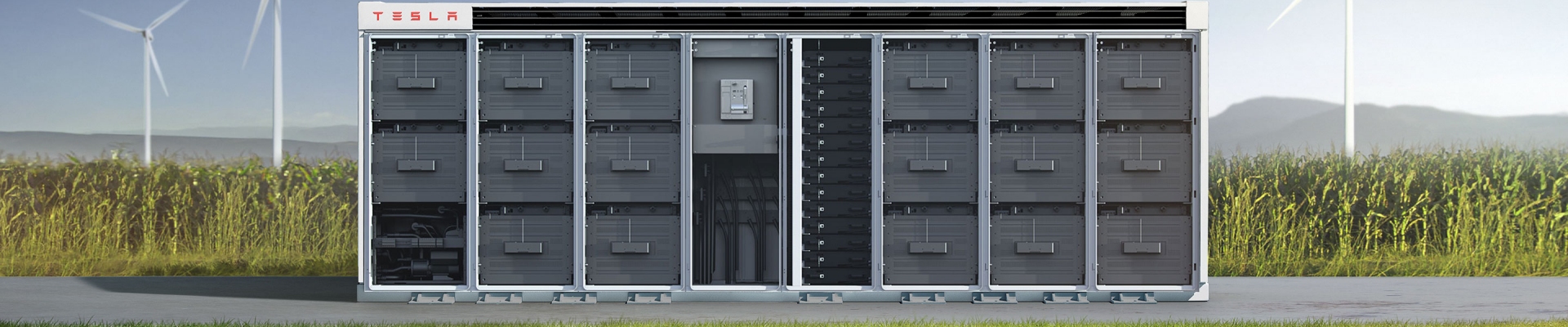
Tesla Megapack 3 + Autobidder - 3.9 MWh per unit; LFP; integrated with Autobidder market dispatch software
LG Energy Solutions LECS - utility and C&I; NMC and LFP variants
Panasonic EverVolt - residential and C&I focus
Notable BESS Deployments Database
Grid-Forming BESS & Virtual Inertia
As coal and gas plants retire, they remove decades of accumulated rotational inertia from the grid. Grid-forming BESS — running virtual inertia control algorithms through SiC-based power conversion systems — replaces that inertia synthetically. The inverter synthesizes a voltage waveform that emulates the electromagnetic behavior of a synchronous machine: inertia, frequency droop response, voltage support — all in software, at millisecond response times no mechanical system can match.
Grid-forming capability is now required or incentivized by grid codes in the UK, Australia, Ireland, and increasingly the US. Every utility-scale BESS in a high-renewable grid is a potential grid-forming asset — making the PCS software stack as strategically important as the battery cells beneath it.
See: Power Electronics & PCS Supply Chain | Grid Infrastructure & Modernization
Market Trends & Outlook 2026-2030
Rapid scaling - Global BESS installations expected to exceed 1,000 GWh annual deployment by 2030, driven by renewables, electrification, and grid modernization programs.
LFP dominance - LFP now controls 90%+ of utility-scale BESS chemistry globally; cost curve continues to fall as Chinese OEM scale increases.
US reshoring - IRA 45X MPTC incentives driving cell, module, and PCS production reshoring; CATL considering US JV; LGES, Samsung SDI expanding US capacity.
Long-duration storage emerging - Projects above 8 hours requiring flow batteries, iron-air (Form Energy), or gravity/thermal alternatives; niche but growing for grid capacity markets.
Co-location with solar and wind - Standalone BESS increasingly replaced by co-located renewable + storage projects; shared grid interconnection reduces cost.
Safety regulation tightening - NFPA 855 and UL 9540/9540A increasingly enforced for permitting and insurance; several high-profile thermal runaway events accelerating regulatory action.
Second-Life BESS
EV batteries retiring from vehicle service typically retain 70-80% of original capacity - sufficient for stationary storage applications with lower C-rate requirements. Second-life BESS systems repurpose these packs for depot energy storage, grid-edge buffering, and behind-the-meter peak shaving. As EV fleet volumes create a reliable feedstock of retired packs with known chemistry and degradation profiles, second-life economics are improving. Key challenges: state-of-health assessment at scale, pack disassembly and reconditioning, warranty and liability frameworks.
See: Battery Recycling & End of Life
BESS Network - SiliconPlans
BESS Guide - specialist coverage of battery energy storage technology, deployment, and market development
Battery Passport Guide - EU Battery Regulation, digital battery passport, and compliance requirements
Battery Compliance Guide - global battery regulatory compliance including IRA, RoHS, REACH, and supply chain due diligence
Related Coverage
BESS Technology: Battery Chemistries | BESS Products Directory | Notable BESS Deployments | BESS Supply Chain | Second Life & Recycling
OEM Platforms: CATL | BYD | LGES | Panasonic
Grid & Microgrids: Grid Infrastructure | Microgrids | Power Electronics & PCS | Energy Orchestration
Fleet & Depot: Fleet Energy Depot | Fleet Charging | Tesla Autobidder
Supply Chain: BESS Supply Chain | Battery Supply Chain | Convergence Map | SiC & GaN Substrate