ElectronsX > Infrastructure > Microgrids > Tesla Megablock Grid Node
Tesla Megablock Grid Node
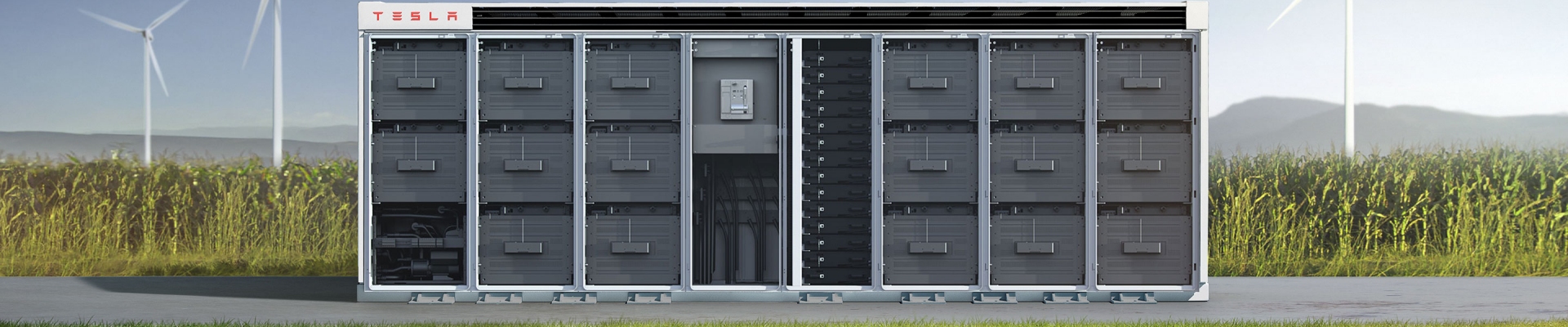
Megablock marks Tesla’s entry as a full grid-hardware OEM. It combines four Megapack 3 batteries, Tesla-built inverters, a Tesla-manufactured transformer, medium-voltage (MV) switchgear, busbars, thermal management, site controls, and an energy management system (EMS) into a single productized grid node. It replaces the traditional field-built substation with transformer plus battery energy storage system (BESS) model with a factory-built, copy-and-paste unit engineered for high-speed deployment.
Tesla delivers a fully integrated, vertically controlled grid node that can be shipped, dropped, connected, and scaled at manufacturing speed instead of construction speed. It turns substation-scale power into a repeatable product and provides the power-quality backbone required for AI datacenters, semiconductor fabs, EV plants, and future Fifth Industrial Revolution (5IR) facilities.
Physical Architecture
Megablock is delivered as a complete integrated skid that contains all major grid-node components in a single factory-assembled product.
- Four Megapack 3 units (5 MWh each) with approximately 20 MWh of total storage per block
- Tesla-built utility transformer with a future path toward solid-state transformer (SST) designs
- Tesla-designed Megapack inverter stack tightly integrated with the packs
- Medium-voltage switchgear and protection equipment on the skid
- Integrated busbars, cabling, relays, and interlocks for safe, repeatable connections
- Heat-pump-based thermal system for packs, power electronics, and transformer
- On-skid controls, EMS, and site controller for local orchestration
- Fully pre-certified grid-interconnect hardware for faster approvals
The entire node ships on a tractor-trailer and is placed on prepared pads with minimal civil work. Electrical and control interfaces are standardized so multi-block arrays can scale without custom engineering each time.
Deployment Model
Megablock is engineered to be deployed at the speed of manufacturing, not traditional construction, with Tesla targeting around 1 GW of installed capacity in about 20 days under ideal conditions.
- In-house transformer production eliminates the historical 12-24 month lead-time bottleneck
- Standardized block-to-block electrical characteristics reduce custom engineering work
- Pre-certified interconnect hardware streamlines interconnection and permitting steps
- Software automatically discovers, identifies, and configures new blocks added to a site
- Minimal civil requirements make pad, trench, and conduit work highly repeatable
- Modular arrays turn grid expansion into a copy-and-paste operation: add blocks, connect, activate
Megablock is treated as a factory product that is shipped, dropped, connected, and brought online, rather than a bespoke construction project assembled piece by piece in the field.
Tesla as a Vertically Integrated Grid OEM
Megablock compresses what used to be a multi-vendor, multi-discipline utility stack into a single vertically integrated Tesla product.
- Battery cells, modules, and Megapack 3 packs are designed and manufactured by Tesla
- Megapack inverters are Tesla-designed and tightly integrated with pack control firmware
- The grid transformer is manufactured by Tesla and optimized for Megapack integration
- Thermal systems are engineered for the combined battery, inverter, and transformer load
- MV switchgear and protection are integrated into the skid-level design
- The EMS, site controller, and orchestration software stack are developed by Tesla
- Market-facing software such as Autobidder and Opticaster are part of the same ecosystem
This mirrors Tesla’s approach in EVs, autonomy, robotics, and stationary storage: own the entire stack from hardware to software so that performance, cost, and deployment speed can be optimized as a single system.
Role in U.S. Resilience and 5IR Reindustrialization
Megablock directly supports the Fifth Industrial Revolution (5IR) goal of combining advanced automation, AI, and clean energy with large-scale reindustrialization.
- Enables rapid expansion of grid capacity where new factories, gigafactories, and data centers are built
- Supports local power autonomy for critical national assets such as AI datacenters and semiconductor fabs
- Provides modular building blocks for regional resilience and distributed energy strategies
- Accelerates build-out of EV charging depots, truck hubs, and logistics nodes
- Reduces dependence on long-lead-time transformer supply chains that slow reindustrialization
As Megablock scales, it becomes a strategic asset for national resilience and economic growth, not just an energy product.
Traditional Substation + BESS vs. Megablock
Conventional substation and BESS projects are complex, slow, and highly customized. Megablock reframes this as a product deployment problem instead of a one-off engineering exercise.
- Traditional builds rely on long transformer lead times that can delay projects by one to two years
- Multiple vendors across transformers, switchgear, BESS, and controls require heavy integration work
- Site-specific engineering and customization inflate costs and extend schedules
- Civil and structural work is substantial and often bespoke for each facility
- Commissioning involves extensive manual validation and multi-party coordination
- Megablock uses Tesla-built transformers with predictable availability
- Electrical and control interfaces are standardized at the block level
- Civil and structural scope is reduced to repeatable foundations and routing
- The entire system is factory-assembled, tested, and shipped as a single skid
- Commissioning is heavily software-driven, with automated discovery and configuration
Megablock's integrated skid design reduces the non-productive electrical infrastructure footprint relative to conventional BESS installations, improving Energy Throughput per Acre for sites where land cost or availability is a constraint.
The overall effect is the same kind of shift seen when automotive manufacturing moved from custom-built vehicles to standardized platforms and high-volume production lines.
AI Datacenters and the Need for Oversized BESS
AI training datacenters built around modern GPUs, tensor processing units (TPU), or neural processing units (NPU) have an electrical profile that is fundamentally different from traditional hyperscale cloud workloads.
- Accelerators can ramp from near-idle to full power within approximately 5 to 30 milliseconds
- Thousands of GPUs often synchronize compute steps, creating massive load ramps and collapses
- Harmonic distortion increases significantly during high-parallel matrix operations
- Voltage and frequency tolerances are extremely tight for stable operation
- Long-running AI training jobs are highly sensitive to any power irregularities or disturbances
For these reasons, BESS in AI datacenters is not just a backup layer; it is an always-on power-quality and stability layer that must be oversized relative to IT load.
- BESS inverter power typically needs to be sized at about 1.2 to 1.5 times the peak IT load
- BESS energy capacity often needs to be in the range of 1.5 to 2.0 times the peak IT load in MWh
- For a 1 GW AI datacenter, that implies 1.2 to 1.5 GW of inverter headroom and 1.5 to 2.0 GWh of storage
- This oversizing is necessary to absorb GPU load spikes, maintain voltage and frequency, suppress harmonics, and provide multi-minute ride-through for grid events
- The grid should see a flat, clean power profile even when the internal compute load is ramping aggressively
Megablock aligns naturally with these requirements because it can be deployed in multi-block arrays that deliver both inverter power and storage capacity in standardized increments, and because Tesla controls the entire stack from battery to transformer to EMS.
- Megapack inverters provide fast response suitable for millisecond-scale GPU load changes
- Parallel Megablocks can be used to achieve the required 1.2 to 1.5 times inverter headroom
- The 1.5 to 2.0 times storage requirement can be met by scaling the number of blocks
- Tesla’s EMS can shape the datacenter’s instantaneous load to appear smooth and grid-friendly
- In-house transformers and modular switchgear avoid the traditional gating factors that slow AI power projects
It is plausible that Tesla will validate Megablock internally as the backbone of its own GPU clusters, such as future Colossus deployments, before or in parallel with broader external rollout.
Cross-Sector Applications
Megablock’s modular, vertically integrated design makes it relevant across a wide range of sectors that need fast, clean, and scalable power.
- AI training datacenters and inference farms requiring ultra-stable, high-density power
- Semiconductor fabs with stringent power-quality requirements
- EV gigafactories that combine large production loads with evolving power needs
- Robotics and advanced manufacturing facilities with variable, automated loads
- Utility operators building new grid-scale storage or upgrade nodes
- Municipal and regional microgrids focused on resilience and local autonomy
- Sustainable estates and large off-grid or grid-optional properties
- Large EV fleet depots for trucks, buses, and robotaxis at MW-to-GW scale
- Remote industrial operations such as mines, ports, or energy hubs
In each case, Megablock functions as a standardized power spine that can be replicated, scaled, and maintained with far less complexity than traditional bespoke infrastructure.
Related Coverage
- Microgrid Power Gen & Storage
- Microgrid Hardware Stack
- Microgrid Controls & Interface
- Microgrid OEMs
- Microgrid OEMs
- Microgrid Deployment Bottlenecks