ElectronsX > Charging Infrastructure > CPO Networks > Tesla Supercharger
Telsa Supercharger Network
[Last updated: Apr 2026]
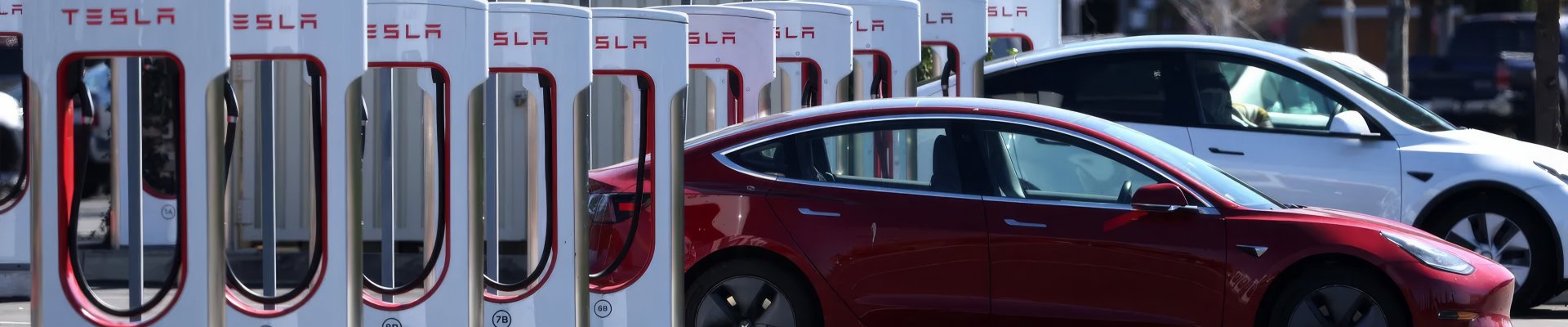
The Tesla Supercharger network is the largest, most reliable, and most widely used public DC fast-charging network in the United States and globally. With approximately 3,031 stations and 36,773 ports in the US alone — 53% of all US DCFC ports — Supercharger is the de facto backbone of long-distance EV travel in North America. Every major automotive OEM has now committed to NACS (SAE J3400), making the Supercharger network accessible to virtually all current and future EVs sold in the US.
The network has expanded from a Tesla-exclusive closed network to the US public charging standard in three years. The transition matters for supply chain and competitive analysis: Supercharger is no longer just a Tesla vehicle perk — it is a revenue-generating charging infrastructure business with 99.95% stated uptime, a cost-per-stall below $45,000 for V3.5 (targeting below $40,000 for V4), and throughput of approximately 1.8 TWh per quarter globally in Q3 2025.
Network Scale - 2026
| Metric | US | Global | Notes |
|---|---|---|---|
| Stations | ~3,031 | ~7,900+ | +21% US stations since start of 2025; Asia-Pacific, North America, Europe roughly equal thirds globally |
| Ports / Stalls | ~36,773 | ~77,000+ | +26% US ports since start of 2025; average ~9.5 stalls per station globally |
| DCFC Market Share (US) | 53% | N/A | More than half of all US DCFC ports; next three networks (Electrify America, EVgo, ChargePoint) each have 4,000-5,500 ports |
| Network Throughput | ~600+ GWh/quarter est. | ~1.8 TWh/quarter (Q3 2025) | ~34-35 kWh per session average; ~7.5 sessions per stall per day globally; ~52M sessions/quarter |
| Uptime | 99.95% stated | 99.95% stated | Industry benchmark; competing networks reported 70-80% uptime in NEVI compliance studies |
| Cost per Stall | Under $45K (V3.5) | Target under $40K (V4) | Significantly below competitor cost per stall; vertical integration of hardware manufacturing key driver |
Supercharger Hardware Generations
| Generation | Max Power | Connector | Key Features | Status |
|---|---|---|---|---|
| V1 | 120 kW (shared across stalls) | NACS (proprietary at time) | Original corridor network; paired stalls share power cabinet | Legacy - most replaced or upgraded |
| V2 | 150 kW per stall | NACS | Paired stalls (A/B) share 150 kW cabinet; still widely deployed | Active - large installed base; some sites being upgraded |
| V3 | 250 kW per stall | NACS; Magic Dock CCS adapter at open-access sites | Independent per-stall power; liquid-cooled cable; on-route charging optimization; credit card reader | Active - current primary deployment generation |
| V4 | 500 kW (passenger) / 1.2 MW (Semi) | NACS; integrated Magic Dock; built-in payment terminal | 3x power density vs V3; one cabinet supplies 8 stalls; supports 1,000V / 1,000A; longer cable for varied port locations; first complete V4 station: Redwood City CA, September 2025 | Scaling - rollout accelerating; will be primary new deployment standard |
Open Access & NACS Transition
The Supercharger network transitioned from Tesla-exclusive to multi-OEM access beginning in 2023. The mechanism is NACS (North American Charging Standard, now SAE J3400) — the connector standard Tesla developed and donated to SAE, which all major OEMs have committed to adopt. Access works through two pathways:
Magic Dock - a captive CCS1-to-NACS adapter built into select V3 and all V4 Supercharger posts; allows any CCS1-equipped EV to charge without a separate adapter; driver reserves via Tesla app; available at 65%+ of US sites
Native NACS - new vehicles from 2025 onward from most major OEMs have NACS ports built in; plug directly into any Supercharger with no adapter required; transitioning vehicles use OEM-provided CCS-to-NACS adapters (~$185-$230)
Pricing for non-Tesla vehicles: Tesla owners pay the lowest rates. Non-Tesla owners pay standard rates or can subscribe to Tesla's Supercharging Membership ($13/month) for reduced rates equivalent to Tesla owner pricing.
OEMs with Supercharger Access (2026)
Ford | Rivian | General Motors | Volvo | Polestar | Nissan | Lucid | Mercedes-Benz | Hyundai | Genesis | Kia | Honda | Acura | Jaguar Land Rover | Audi | Porsche | Toyota | Volkswagen | Subaru | BMW | Stellantis (Jeep, Dodge, Ram - 2026)
Stellantis vehicles with CCS1 ports access Superchargers via Magic Dock or adapter. New Stellantis models from 2026 onward launch with native NACS ports.
Supercharger for Business & Project Oasis
Tesla's Supercharger for Business program allows third-party property owners (retailers, hotels, restaurants, parking operators) to host Tesla-owned and Tesla-operated Supercharger stations. The property owner provides the location and electrical infrastructure; Tesla installs, owns, and operates the equipment. This model has accelerated network buildout by reducing Tesla's real estate and permitting burden.
Project Oasis is Tesla's high-stall-count flagship station program. The Firebaugh, California station expansion to 304 stalls is the largest planned deployment — designed for I-5 corridor volume. Stations with 10+ stalls are being prioritized in new builds; in 2025, at least 353 US stations with 10+ stalls were added, reducing congestion at high-traffic sites.
Browse US Supercharger Stations by State
Station and port data is DB-driven and updated regularly. California leads with 641 stations and 10,538 ports. Florida (237 stations), Texas (216), and New York (123) follow. Select a state to view station list, locations, stall counts, and V2/V3/V4 generation data where available.
Alabama | Alaska | Arizona | Arkansas | California | Colorado | Connecticut | DC | Delaware | Florida | Georgia | Hawaii | Idaho | Illinois | Indiana | Iowa | Kansas | Kentucky | Louisiana | Maine | Maryland | Massachusetts | Michigan | Minnesota | Mississippi | Missouri | Montana | Nebraska | Nevada | New Hampshire | New Jersey | New Mexico | New York | North Carolina | North Dakota | Ohio | Oklahoma | Oregon | Pennsylvania | Rhode Island | South Carolina | South Dakota | Tennessee | Texas | Utah | Vermont | Virginia | Washington | West Virginia | Wisconsin | Wyoming
Data sourced from DOE AFDC and Tesla financial reports. Station counts change as new sites open. See Tesla's official Supercharger locator for real-time station status.
Related Coverage
All CPO Networks Directory
EVSE Hardware & Equipment
Charging Infrastructure Overview
Public DCFC Charging Costs
Tesla Fleet Depot Charging Costs
Tesla Autobidder for Fleet Operators
EVSE Supply Chain
Power Electronics - SiC in Supercharger Hardware