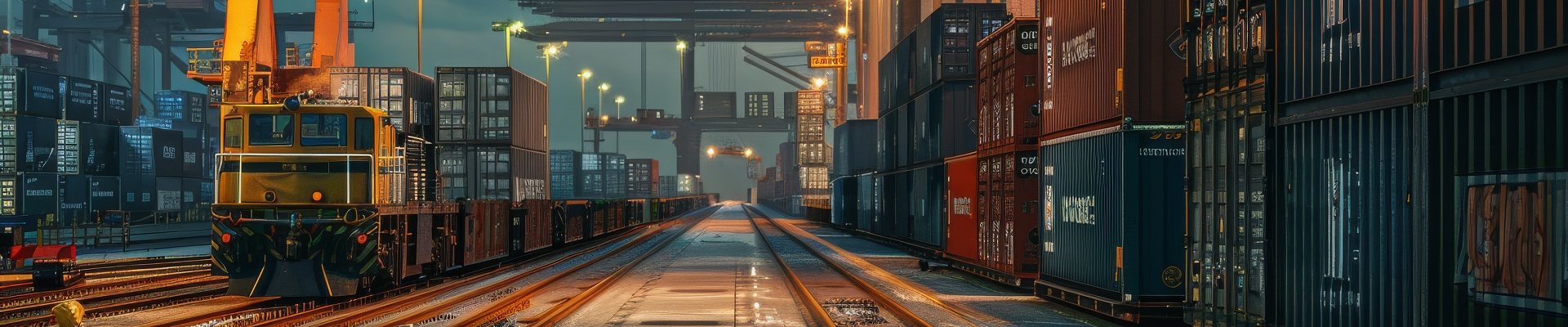
Electric rubber-tired gantry cranes are container-handling cranes used for stacking and transferring containers within ports and intermodal terminals.
They are a high-leverage electrification target because hoist events create large power bursts and the fleet scales to site-level demand.
Electrification and automation both increase the importance of buffering, clean power, and resilient yard energy infrastructure.
What RTG Cranes Do
| Attribute |
Typical Reality |
Why It Matters |
| Asset type |
Rubber-tired gantry crane used for container stacking and transfer |
Defines the highest-energy mobile equipment class in many container yards |
| Operating domain |
Container yards and intermodal terminals |
Highly repeatable motion patterns enable automation and predictable energy demand |
| Duty profile |
Lift and travel cycles with short high-power events |
Creates power spikes that drive power-quality and buffering requirements |
| Fleet deployment |
Multiple cranes per terminal |
Aggregate peak demand becomes a site-level grid and substation problem |
Electric RTG crane list
| OEM
| Model
| Control Mode
| Cost Band
|
help
Electrification Pathways
| Electrification Path |
What Changes |
Primary Value |
| Diesel-hybrid RTG |
Adds energy recovery and a smaller energy buffer |
Reduces fuel and emissions without full grid dependence |
| Trolley or busbar electric RTG |
Connects to electrified runway segments |
Cuts diesel runtime while preserving mobility |
| Cable reel electric RTG |
Runs fully electric with reel-fed power |
Eliminates diesel on the crane; high uptime with grid connection |
| Battery electric RTG |
Uses onboard battery for travel and lift events |
Enables zero local combustion with buffering; reduces peak draw with control |
Energy and Power Envelope
Bands describe the operating class without implying vendor-specific specifications. Exact values vary by crane size, spreader, lift height, and site throughput targets.
| Parameter |
Typical Band |
Notes |
| Power input class |
Medium-voltage AC service feeding crane drives |
Often a terminal-level infrastructure dependency |
| Internal DC bus class |
High-voltage DC bus inside the crane drive system |
Exact values vary by design and vendor |
| Peak power events |
Multi-hundred kW to multi-MW bursts during hoist events |
Power spikes dominate infrastructure planning |
| Energy buffering |
Onboard buffer or stationary buffer depending on architecture |
Buffers reduce grid peaks and improve power quality |
| Planning metric |
Moves per hour and availability rather than vehicle range |
Energy is a throughput constraint, not a distance constraint |
Automation and Autonomous Operation
Automation changes yard throughput, safety workflows, and utilization targets. Higher utilization increases sensitivity to power quality and peak demand management.
| Automation Mode |
Operational Meaning |
Typical Requirements |
Energy Implication |
| Manual operation |
Operator-controlled crane with standard safety systems |
Standard terminal controls and procedures |
Electrification reduces fuel but does not change utilization limits |
| Assisted operation |
Automation assists positioning and anti-sway functions |
Sensors and control upgrades |
Improves productivity and repeatability of power events |
| Automated RTG |
Automated stack moves under supervisory control |
Site mapping, safety case, control integration |
Higher duty intensity increases importance of buffering and clean power |
Infrastructure Trigger Points
| Trigger |
What Appears On Site |
Next Infrastructure Step |
| More cranes or higher throughput targets |
Substation and feeder limits appear quickly |
Upgrade service capacity and distribution |
| Power quality issues |
Voltage sag, flicker, nuisance trips |
Add buffering and power conditioning |
| Long grid upgrade timelines |
Interconnect and transformer delays |
Stage with BESS and microgrid control strategy |
| Automation rollout |
Higher utilization and tighter uptime requirements |
Increase redundancy, buffering, and monitoring |
Digital Systems and Connectivity Signals
| Capability |
How To Represent |
Why It Matters |
| Crane control integration |
Compatible / OEM-dependent / unknown |
Determines feasibility of automation and orchestration |
| Telemetry and diagnostics |
Standard / optional / unknown |
Enables maintenance optimization and energy analytics |
| Remote supervision |
Supported / OEM-dependent / unknown |
Key for automated operations and safety cases |
| OTA updates |
None / limited / full / unknown |
Signals software-defined maintainability over decades |
Related Coverage