ElectronsX > Systems > EV Platforms > Rivian EV Platforms
Rivian EV Platforms
This article summarizes Rivian's major EV platforms and why they matter. A platform is not just a chassis. It is a layered system that shapes real-world behavior: charging curve stability, sustained performance, thermal limits, software longevity, and autonomy headroom.
What a Rivian platform controls
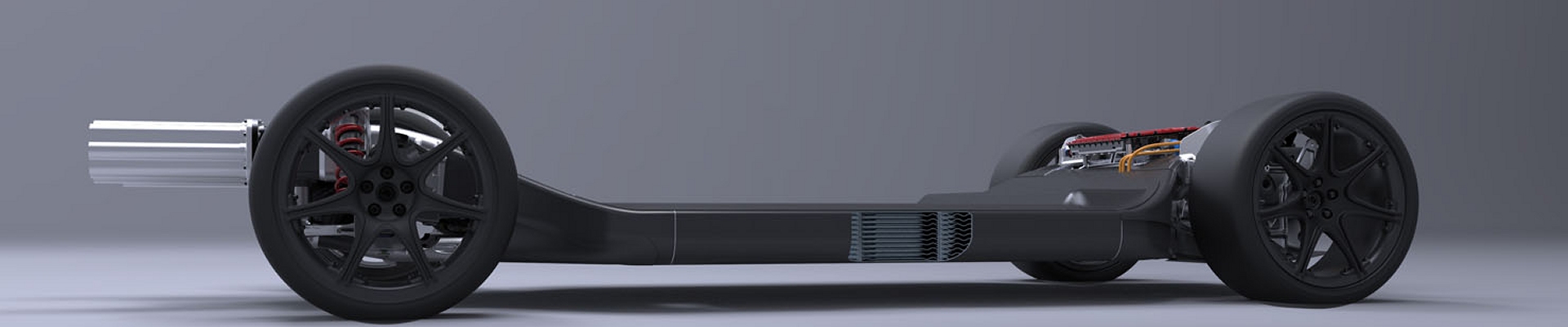
Rivian's approach is best understood as a “skateboard” physical platform plus a strong electrical/software architecture layer that reduces wiring and controller sprawl.
- Structural and energy layer: skateboard layout, pack placement, crash structure, suspension hard points
- Powertrain and charging layer: voltage class and charge-rate behavior; thermal headroom for sustained output
- Zonal electrical architecture: vehicle functions grouped by zones to reduce wiring and consolidate controllers
- Software + OTA layer: unified software stack and OTA scope that can improve features over time
Rivian platform roadmap
Rivian's platform roadmap can be summarized as:
- R1 platform: the foundational consumer platform (R1T/R1S), updated with a newer electrical architecture generation
- Commercial Van platform: fleet-first van architecture (often referenced as RCV) derived from Rivian's core skateboard approach
- R2 platform: next major mass-market platform family (mid-size), designed for lower cost and higher volume
- SDV direction: deeper controller consolidation and software standardization, including work with the VW Group joint venture on zonal SDV architectures
Rivian EV platform lineup
| Platform / Architecture | Primary Use | Voltage / Charging | Architecture Direction | Representative Examples |
|---|---|---|---|---|
| R1 platform | Consumer pickup + SUV (premium, high-capability) | Program dependent; charging behavior varies by variant | Core skateboard with increasingly consolidated E/E architecture | R1T, R1S |
| Zonal electrical architecture (R1 Gen update) | Electrical architecture layer used to reduce wiring + ECUs | Not a voltage spec | Zonal controller approach; reduces wiring and simplifies manufacturing | “New R1” generation update |
| RCV / Commercial Van platform | Commercial delivery vans (fleet-first) | Segment-typical charging behavior; exact specs vary by van size | Skateboard-derived commercial platform; optimized for uptime and serviceability | Rivian Commercial Van (500/700 class) |
| R2 platform | Next-gen mid-size consumer platform family | Rivian leadership has publicly downplayed the need for 800 V-class on R2/R3-sized products (program dependent) | Cost-down, higher-volume platform; SDV-first simplification is a key goal | R2 (and related future derivatives) |
| VW Group joint venture SDV architecture work | Zonal SDV architecture + functional software (shared development) | Not a voltage spec | Modular central computers controlling vehicle functions by zones | Rivian + VW Group technology roadmap |
R1 platform
The R1 platform is Rivian's foundational consumer platform. What matters most for platform-level understanding is not the trim list, but the underlying architecture choices that affect long-term software and service complexity.
What the R1 platform tends to enable:
- High capability envelope (towing, off-road, performance variants)
- Large-pack thermal strategies that support sustained power delivery
- Platform reuse across multiple top-hat bodies (pickup vs SUV)
See the R1 platform page.
Zonal electrical architecture (why it matters)
Rivian has described a zonal electrical architecture approach that reduces wiring length and consolidates electronics into zone-based controllers, improving manufacturing simplicity and future software extensibility.
What zonal architecture tends to enable:
- Reduced wiring harness mass and complexity
- Fewer discrete ECUs and clearer OTA boundaries
- Improved serviceability through standardized zone modules
See the Zonal E/E architecture page.
Commercial Van platform (RCV)
Rivian's commercial vans (such as the RDV vans used by Amazon) are built around a fleet-first platform approach (often referenced as RCV) that leverages a skateboard-like base while optimizing for uptime, driver ergonomics, and service access. The commercial program matters because it forces “operations-grade” design decisions: durability, maintenance cadence, and predictable charging workflows.
See the Commercial Van platform page.
R2 platform (next-gen)
R2 is Rivian's next major platform family aimed at scaling volume with lower cost. Public statements attributed to Rivian leadership suggest that ultra-high-voltage (800 V-class) is not viewed as essential for R2/R3-sized products, implying a focus on system-level optimization rather than headline peak charge voltage.
See the R2 platform page.
Related Coverage
- Tesla EV Platforms
- Hyundai Motor EV Platforms
- General Motors EV Platforms
- Volkswagen Group EV Platforms
- Geely EV Platform Families
- BYD EV Platform Families
- Mercedes-Benz EV Platforms
- BMW Group EV Platforms